Loading…

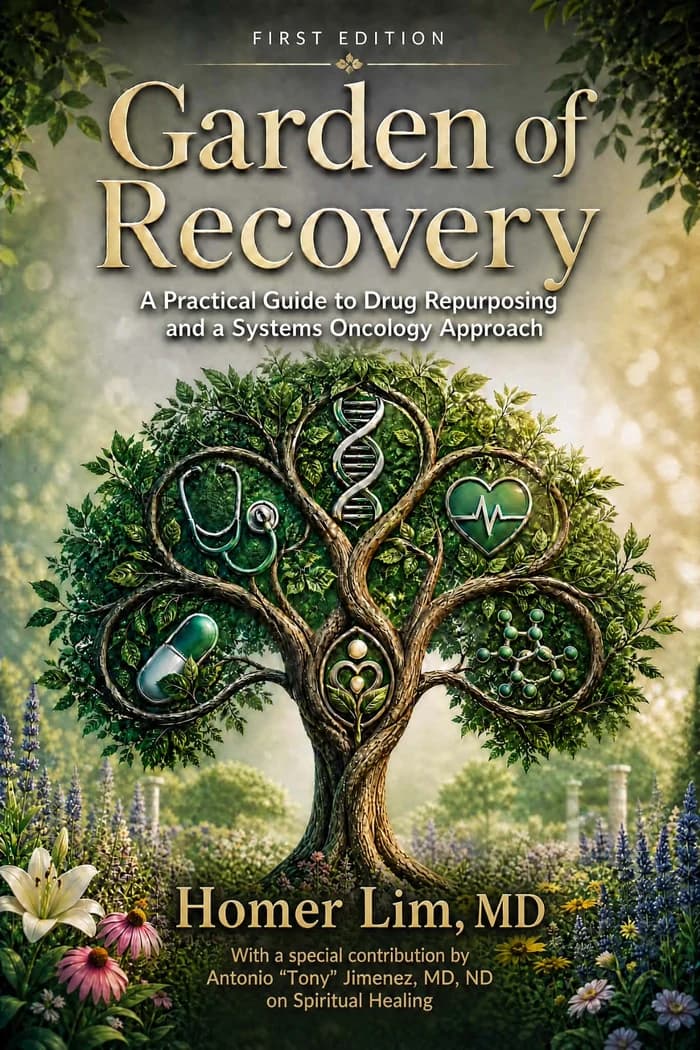
A Practical Guide to Drug Repurposing and a Systems Oncology Approach
The book presents cancer as "a complex, evolving biological system" rather than an isolated problem. It integrates systems oncology, precision diagnostics, modern treatments, drug repurposing, nutraceuticals, and supportive care into one practical framework designed for patients and families.
Dr. Lim is the physician who presents the workshop on this site. What follows describes what his book covers, in the book's own terms. Nothing on this page is a treatment recommendation.
The book "uniquely connects biological cancer characteristics to treatment response and explores established medications being investigated for potential cancer applications."
The description continues: "It also emphasizes comprehensive care including nutrition, physical activity, sleep, and stress management alongside medical treatment."
The book names its intended readers as:
This site's audience is physicians; the book is written for patients and families. Both are true at once, and the difference is worth holding on to while reading the sections below.
The framing the whole book works from: cancer as an interconnected system rather than an isolated problem.
Metabolic behaviour, and the tissue environment immediately around a tumour.
Immune interaction, and how the disease is described as changing over time.
Why treatments stop working, and the diagnostic tools the book discusses for tracking that.
Established treatment, alongside the repurposing material summarised below.
Nutrition, physical activity, sleep and stress management as described alongside medical treatment.
Topic areas as listed on the book's own website. Chapter titles and ordering in the published book may differ.
Two consequences follow from that definition on the book's own site. The first is that "Cancer behaves as a complex adaptive system." The second is headed "Treatment Changes the System" — the argument that treatment itself alters what is being treated, so care needs "ongoing evaluation rather than relying on a single treatment plan throughout the disease journey."
The book defines the term plainly: "Drug repurposing involves investigating an existing medicine for a new therapeutic purpose."
Its stated rationale is that existing medicines come with "substantially more pharmacological and safety information" than new compounds, and that many of them act on "pathways involved in metabolism, inflammation, angiogenesis, immunity."
Eight groups, with the examples the book names in each:
metformin, statins, aspirin
ivermectin, mebendazole, fenbendazole
hydroxychloroquine, artesunate
itraconazole
doxycycline, clarithromycin
cimetidine, low-dose naltrexone
propranolol, losartan, ACE inhibitors
disulfiram, celecoxib, methylene blue, high-dose vitamin C
Naming a medicine here records that the book discusses it. It is not a statement that the medicine treats cancer, and none of these is an approved cancer treatment on the basis of the research the book reviews.
The book uses the term for "foods, nutrients, plant-derived compounds, medicinal mushrooms and other natural substances that may have biological effects beyond basic nutritional requirements."
In an oncology context it reports that "some nutraceuticals are being studied for their effects on pathways involved in inflammation, oxidative stress, metabolism, angiogenesis, immunity, cellular signaling and other aspects of cancer biology."
Dr. Homer Lim is "a physician from the Philippines who has dedicated his career to developing systems-based approaches to cancer care." His clinical work emphasises how "cancer metabolism, inflammation, immune function, the tumor microenvironment, and cellular signaling interact," and he explores "drug repurposing, intravenous therapies, nutraceuticals, metabolic interventions, and supportive care while prioritizing evidence-based, supervised patient care."
The question he gives as the book's guiding one: "How can we support the whole patient while treating the cancer?" The book, in his framing, "translates complex systems oncology and precision medicine into accessible language for patients and families."
Antonio "Tony" Jimenez, MD, ND, contributes a section on spiritual healing as part of comprehensive cancer care.
He also presents the recorded workshop on this site — see the course →
Four responses published on the book's own website. They are reproduced with the names and descriptions their authors gave, and we have not independently verified them.
Dr. Lim has synthesized and vastly expanded these foundations into this remarkable new book.
This book is a gift. I wish I'd had it when I was first diagnosed.
Garden of Recovery is a compassionate reminder that cancer care is about caring for the whole person.
I am a happy cancer patient. What he shared in this book has helped me a lot.
These are personal accounts, not clinical evidence. No outcome described above should be expected from reading this book, or from any medicine or supplement it discusses. Source: gardenofrecovery.com (Testimonials).
Reproduced and condensed from the disclaimer published on the book's own website. Where it is quoted, the wording is exact.
Quoted from the book's own disclaimer. "This website" there refers to gardenofrecovery.com — the same instruction applies to this page.
These are the publisher's own retail listings. Buying there is a purchase from Apple or Amazon, not from NS Videos, and it will not appear in your account here.